Learn · Lace knitting
How to Read a Lace Knitting Chart
A lace knitting chart is a picture of your lace on a grid: every square is one stitch, and the symbol in it tells you what to do with that stitch. You read it from the bottom up, row 1 first, and in most lace the yarn overs and decreases of each row balance out. Here is each step, drawn out on a little eyelet heart.
The short version
- Every square is one stitch; the key tells you what each symbol means.
- Row 1 is the bottom row. Start at the bottom right and work up the chart.
- Knitting flat: right-side rows from right to left, wrong-side rows from left to right. In the round: every round from right to left.
- A yarn over adds a stitch, a decrease takes one or two away; in most lace they balance out in every row.
- Skip grey no-stitch squares, and work the boxed repeat as many times as the pattern says.
1Every square is one stitch
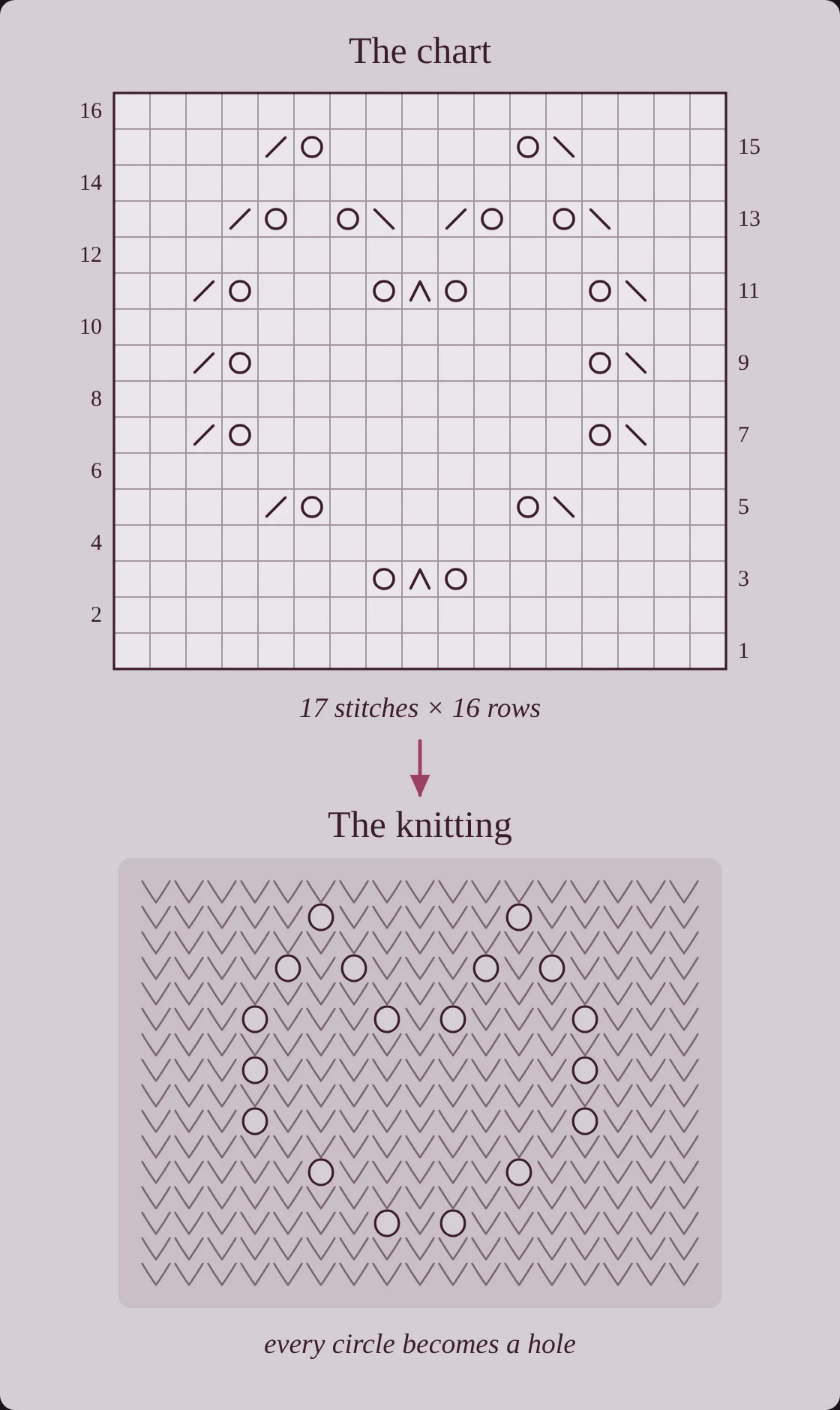
A lace chart is a picture of your knitting, seen from the right side. Each column of squares is one stitch, and each row of squares is one row of knitting. The heart in this guide is 17 stitches wide and 16 rows tall.
The empty squares are plain stockinette. The circles are yarn overs, the little holes of lace, and the slanted lines beside them are decreases. Look at where the circles sit on the chart, then look at the knitting: the holes are in exactly the same places. A heart on the chart is a heart in your lace.
2Read the key first
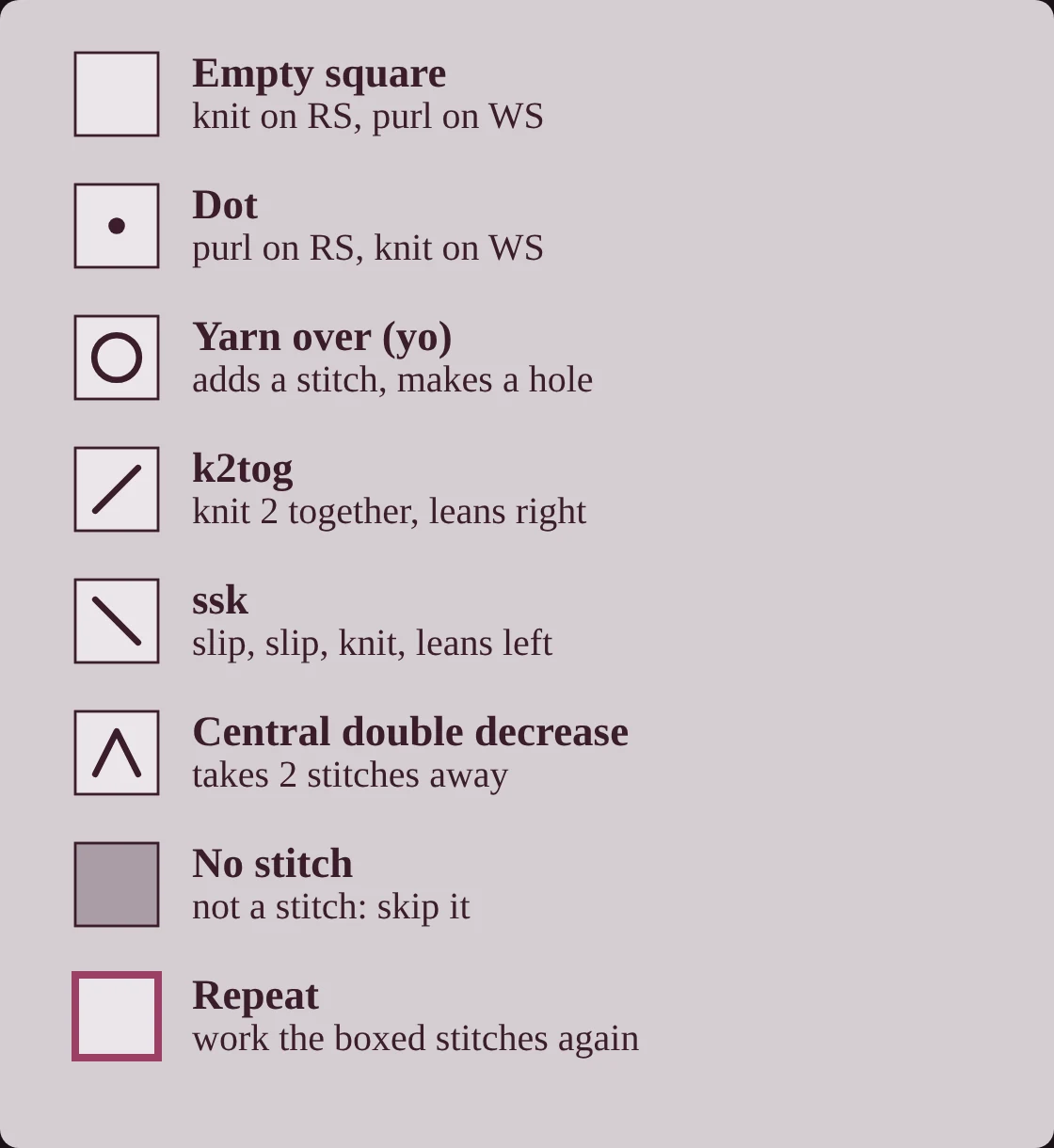
Knitting symbols are not universal. Most designers use similar ones, but the key next to the chart is the only thing that tells you for sure what each symbol means in that pattern. Read it before you cast on, and keep it next to you while you knit. These are the symbols in this guide:
- Empty square: knit on a right-side row, purl on a wrong-side row.
- Dot: purl on a right-side row, knit on a wrong-side row.
- Circle: yarn over (yo). Bring the yarn over the right needle to make a new stitch and a hole.
- / k2tog: knit 2 stitches together. It leans to the right.
- \ ssk: slip 2 stitches knitwise, one at a time, then knit them together through the back loops. It leans to the left.
- Λ central double decrease (cdd): slip 2 stitches together knitwise, knit 1, then pass the 2 slipped stitches over. Three stitches become one, and the middle one sits on top.
- Grey square: no stitch. More about these further down.
A little trick for the slanted lines: they lean the same way as the decrease in your knitting. A / leans to the right, a \ to the left.
3Row 1 is at the bottom
Knitting grows upwards, and so does the chart. Row 1 is the lowest row, the first row you knit, and you work up from there. When you reach the top, the chart is finished, or you go back to row 1 if the pattern tells you to repeat it.
The row number sits on the side where that row starts. On the heart chart the odd numbers are on the right and the even numbers on the left, and that already tells you which way to read.
4Which way to read each row
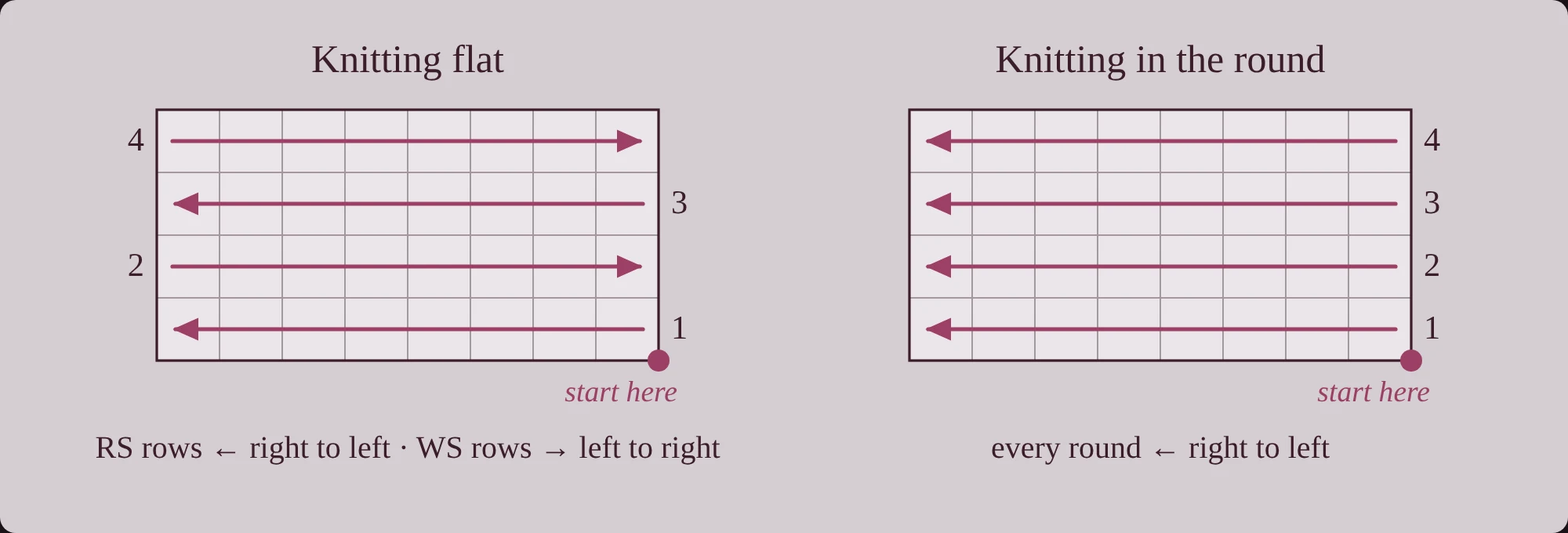
Knitting flat, you start at the bottom right. Right-side rows (here the odd rows) are read from right to left, in the order you work the stitches off your left needle. Then you turn the work, and wrong-side rows (the even rows) are read from left to right: you are travelling back across the same stitches from the other side.
That is also why an empty square means knit on the right side but purl on the wrong side. Either way the stitch looks like a knit stitch from the right side, and the right side is what the chart shows.
Knitting in the round, you never turn the work, so every round is a right-side round, and every round is read from right to left. All the round numbers sit on the right.
Only odd rows? Many lace charts show only the right-side rows: the numbers go 1, 3, 5, 7, and the pattern tells you what to do on the wrong-side rows, very often “purl all stitches”. On the way back a yarn over is a stitch like any other, so purl it too, unless the pattern says otherwise.
5Yarn overs and decreases come in pairs
Here is the secret of most lace. Every yarn over adds a stitch and makes a hole; every decrease takes stitches away. When the yarn overs in a row add as many stitches as its decreases take away, the stitch count stays the same, and the chart stays a neat rectangle.
- A circle adds 1 stitch.
- A / or a \ takes 1 stitch away.
- A Λ takes 2 away, which is why you often find it with a yarn over on each side.
Read row 11 of the heart from right to left: k2, ssk, yo, k3, yo, cdd, yo, k3, yo, k2tog, k2. Four yarn overs (+4), an ssk and a k2tog (−2) and one central double decrease (−2) add up to zero: 17 stitches before the row, 17 after it.
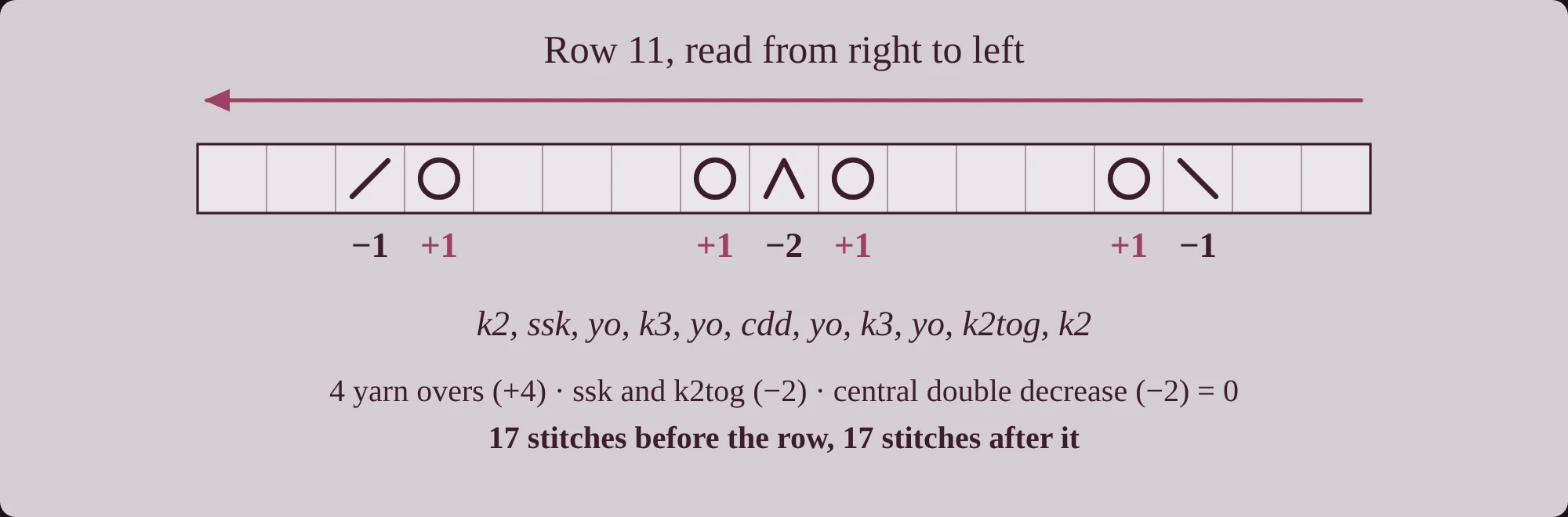
If your count is off at the end of a row, a forgotten yarn over is the usual suspect. Count the circles on the chart, count the yarn overs on your needle, and you will usually find it straight away. When you draw charts of your own, our free Chart Maker does this sum for you: it checks every row for yarn overs against decreases and writes each row out in words.
6The grey squares that aren’t there
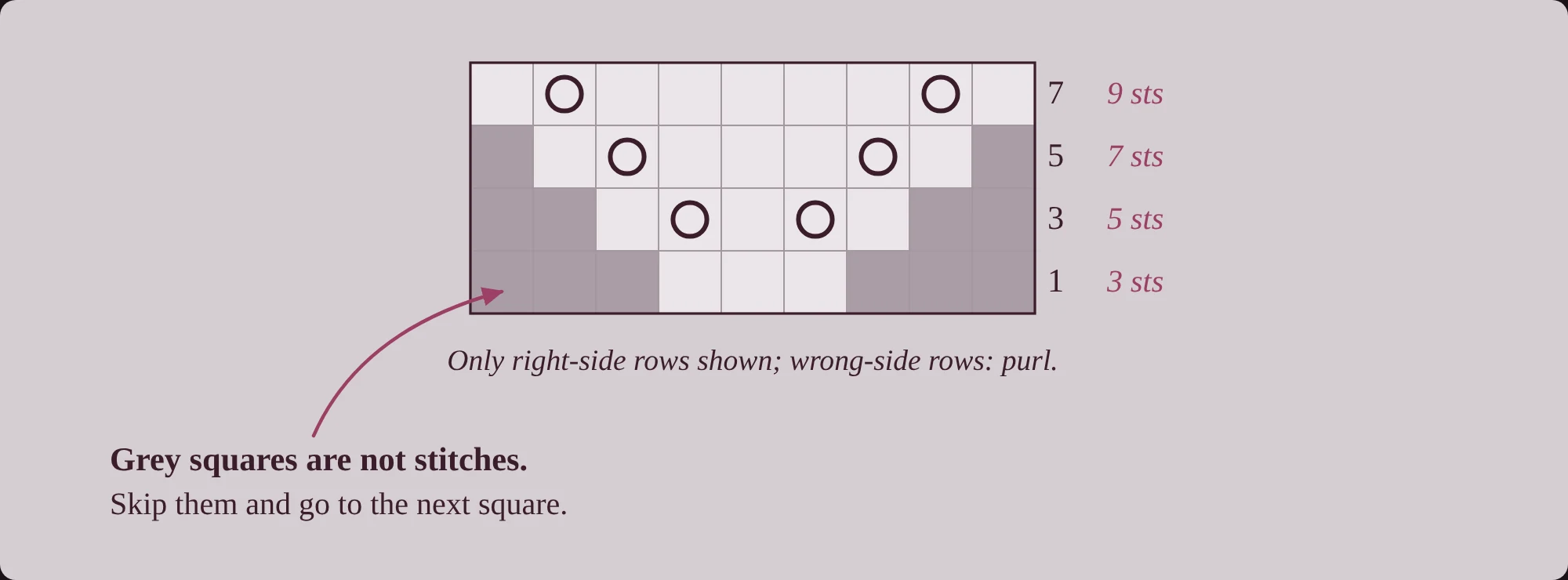
Sometimes a row really does gain or lose stitches: a shawl that grows from the neck, an edging that scallops in and out. A chart is still a grid, so the empty corners are filled with no-stitch squares, usually grey. They are placeholders, not stitches.
When you meet one, skip it and go straight on to the next square. Don’t count it, and don’t leave a gap: the stitches on either side simply sit next to each other on your needle. In the little chart below, every right-side row has two yarn overs and no decreases, so the knitting grows by two stitches each time and slowly fills the grey corners.
7Repeats and edge stitches
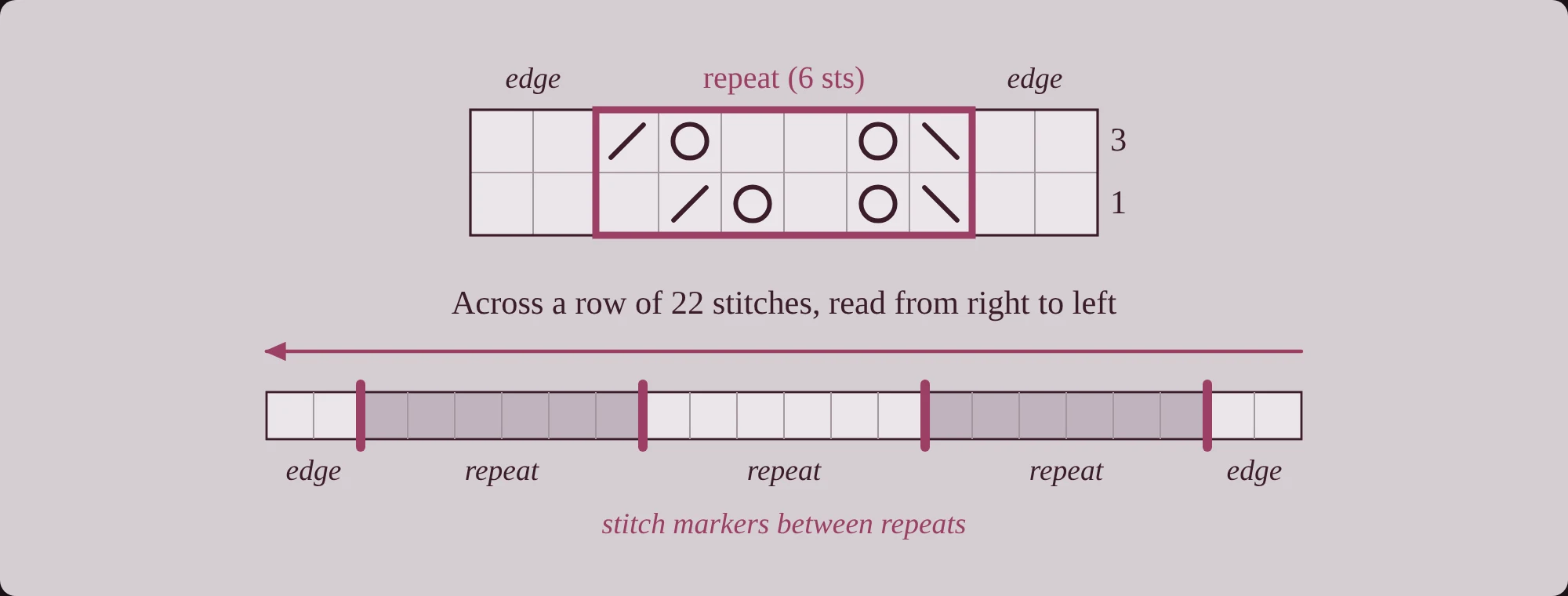
A wide piece of lace isn’t charted from edge to edge. A heavy outline, sometimes in a colour, marks the repeat: a group of stitches you work again and again across the row. The squares outside the box are edge stitches, worked only once.
On a right-side row, work the edge stitches on the right, then the boxed stitches as many times as the pattern says, and finish with the edge stitches on the left. A wrong-side row goes the same way in the other direction. Put a stitch marker between repeats: every section between two markers should look the same, and if one has a stitch too many or too few, you know exactly where to look.
8Keeping your place
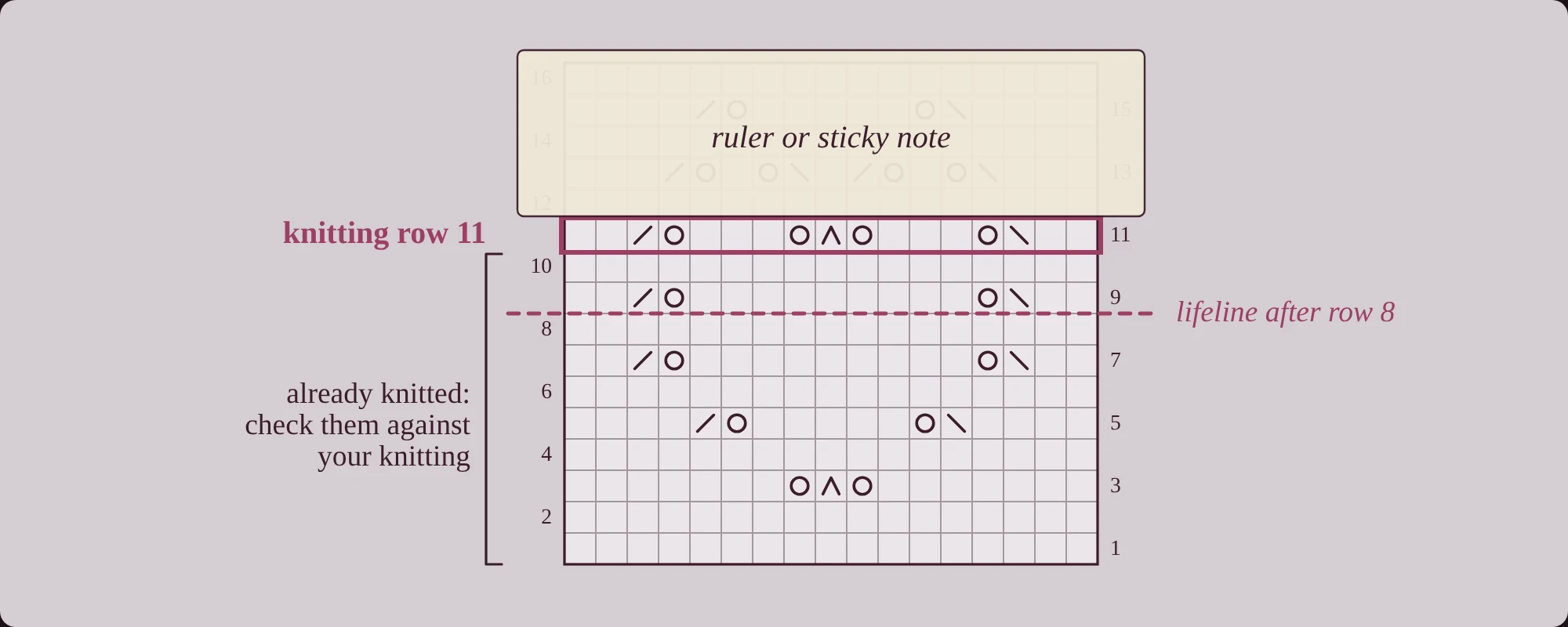
Lay a ruler, a magnetic strip or a sticky note across the chart just above the row you are knitting. The rows you have done stay visible below it, and they should look just like your lace. Finish the row before you put your knitting down, tick off each row on a printed chart, or keep the guided row counter on this site open beside you.
And thread a lifeline every so often: after a plain row, run a smooth thread through all the stitches on your needle and note the row number. If something goes wrong further up, you can rip back to the lifeline without losing a single stitch.
9Try it on a small chart
The heart makes a lovely first lace chart: 17 stitches, 16 rows, three kinds of decrease and plenty of calm knitting in between. Cast on 17 stitches in a smooth, light-coloured yarn, follow the chart from row 1 and purl all the wrong-side rows. Stockinette likes to curl, so for a flat little swatch add a few garter ridges below and above the chart and 2 garter stitches at each side (cast on 21 instead of 17). A gentle blocking at the end opens up the holes.
To check yourself, here is every right-side row in words:
- Row 1: k17.
- Row 3: k7, yo, cdd, yo, k7.
- Row 5: k4, ssk, yo, k5, yo, k2tog, k4.
- Rows 7 and 9: k2, ssk, yo, k9, yo, k2tog, k2.
- Row 11: k2, ssk, yo, k3, yo, cdd, yo, k3, yo, k2tog, k2.
- Row 13: k3, ssk, yo, k1, yo, k2tog, k1, ssk, yo, k1, yo, k2tog, k3.
- Row 15: k4, ssk, yo, k5, yo, k2tog, k4.
- All even rows: purl.
Nupps, the little bobbles in many lace charts, have a guide of their own: How to Knit a Nupp. And if you know filet crochet, How to Read a Filet Crochet Chart works the same way, square by square.
10Lace charts to knit next
Sempervivum has a written version of every round next to its lace charts, so you can check one against the other. Polypodium and Syringa add nupps, and Polypodium cables too.
Sempervivum
Toe-up lace ankle socks with open rosettes round a nupp, a twisted rib and a mini ruffle with picots.
Polypodium
A lace hat and scarf with evergreen ferns, frost diamonds with nupps, little twisted cables and mini ruffles with picots.
Syringa
A lace cardigan with leaves in an eyelet trellis, lilac vines by the buttons, a lilac wreath on the round yoke and mini ruffles with picots.
11Questions
Do you read a lace knitting chart from the top or the bottom?
From the bottom. Row 1 is the lowest row of the chart, and you work upwards, just as the knitting grows.
Which way do you read the rows of a knitting chart?
Knitting flat, right-side rows go from right to left and wrong-side rows from left to right. Knitting in the round, every round goes from right to left.
Why does my lace chart show only odd-numbered rows?
The wrong-side rows are left out, and the pattern tells you what to do on them, very often simply “purl all stitches”. Knitting flat, read every row shown on the chart from right to left.
What do I do with yarn overs on the wrong side?
Work them like any other stitch, usually by purling them, unless the pattern says otherwise. A yarn over sits a little slanted on the needle and is easy to miss.
What does a grey square mean in a knitting chart?
No stitch. It is a placeholder where the row has fewer stitches; skip it and go on to the next square.