Learn · Filet crochet basics
How to Read a Filet Crochet Chart
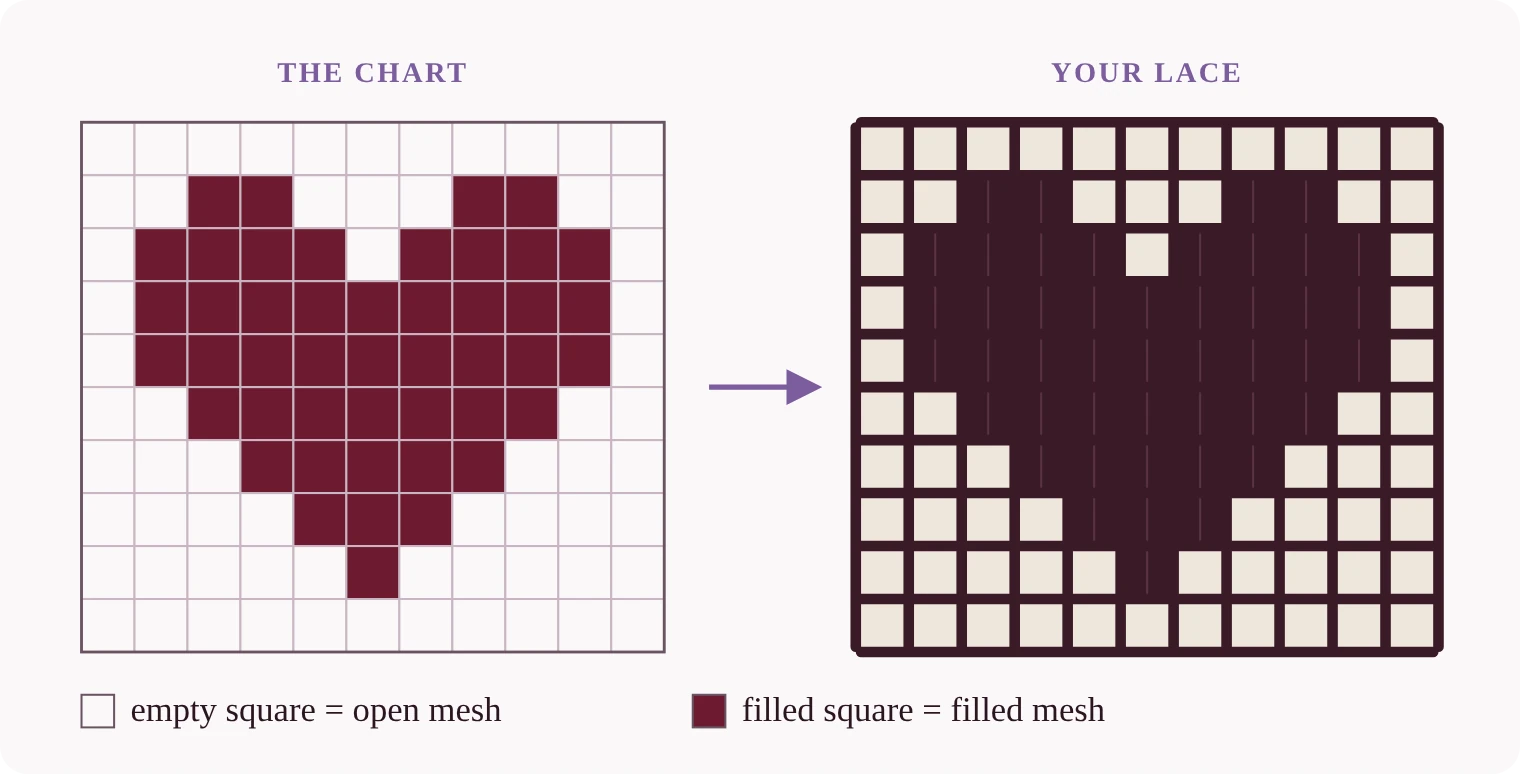
A filet crochet chart is a grid of squares, and every square is one mesh of your lace: an empty square is an open mesh, a filled square is a filled one. You read it from the bottom up, row 1 first, and change direction every row. Here is each step, drawn out stitch by stitch.
The short version
- Every square is one mesh: an empty square is an open mesh, a filled square a filled mesh.
- Row 1 is the bottom row. Work up the chart.
- Odd rows go from right to left, even rows from left to right (if you crochet right-handed).
- The row number sits on the side where that row starts.
- Work row 1 into a chain of 2 × its meshes + 3 (for the ch-1 mesh shown here).
1Every square is one mesh
A filet chart is a picture of your lace, seen from the right side. Each square stands for one mesh, the little box of thread that filet crochet is made of. An empty square becomes a hole, an open mesh. A filled square becomes a solid block, a filled mesh. The design is drawn in filled meshes on a background of open ones, so a heart on the chart is a heart in your lace.
Some charts mark the filled squares with a cross or a dot instead of a colour. The key next to the chart always tells you which is which.
2What a square means in stitches
Filet crochet needs only two stitches: the chain (ch) and the double crochet (dc). We use US terms; in UK terms the dc is called a treble (tr).
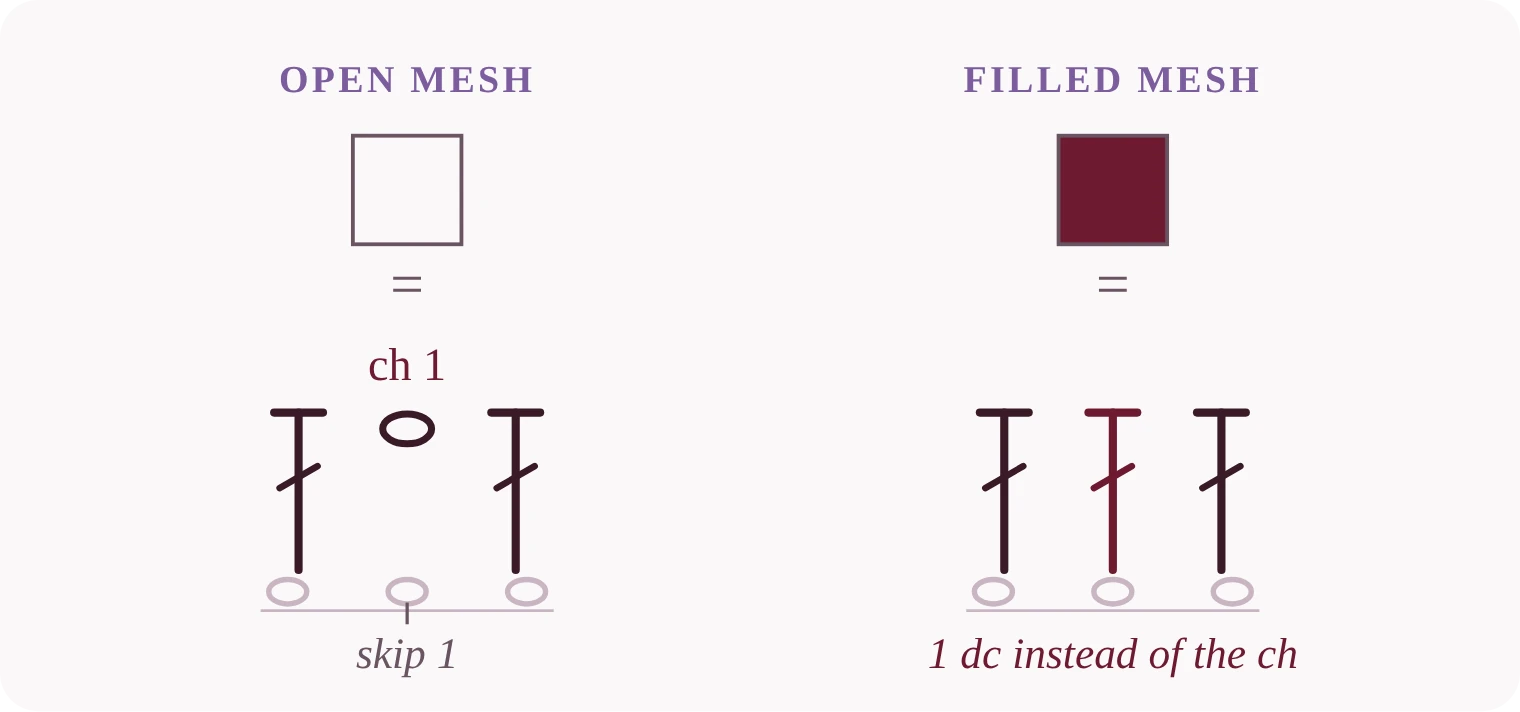
Every mesh stands between two dc, like a little window between two posts:
- Open mesh: ch 1, skip 1 stitch, dc in the next dc.
- Filled mesh: dc in the middle stitch of the mesh below (the chain space or the dc), then dc in the next dc.
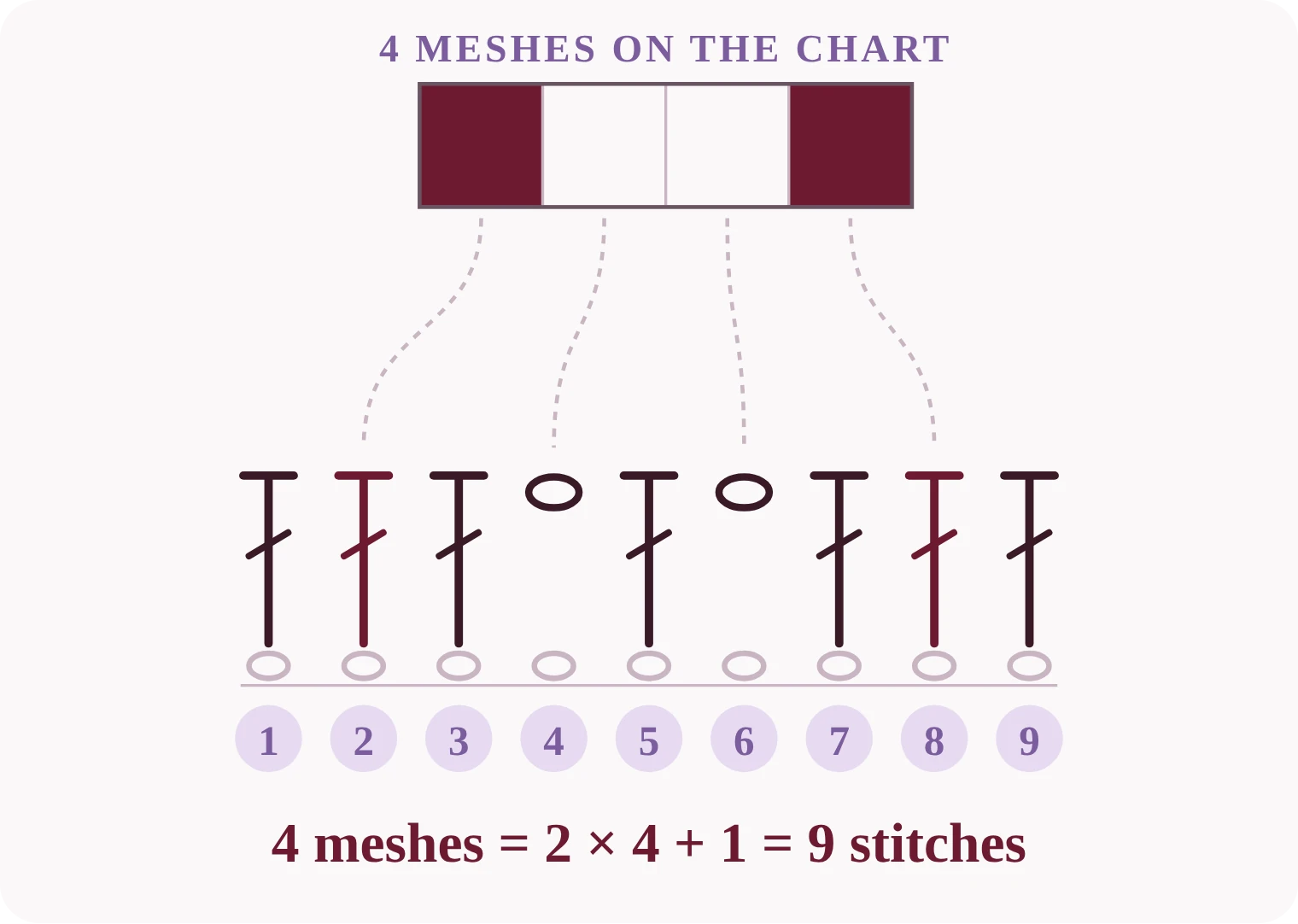
Neighbouring meshes share the post between them. So a row of N meshes has 2N + 1 stitches: one post to start with, then two stitches for each mesh. It makes a handy check at the end of a row.
Ch 1 or ch 2? Many patterns, especially older ones, make a bigger mesh, with ch 2 in an open mesh and 2 dc in a filled one, so each square takes three stitches. The chart is read in exactly the same way; only the stitches inside each square change. The key in every pattern says which mesh it uses, and the drawings in this guide show the ch-1 mesh from our patterns.
3Where to start: row 1 is at the bottom
Filet crochet grows upwards, and so does the chart. Row 1 is the lowest row, and you work up from there. Row 1 is worked into a foundation chain (counting it comes further down); every row after that is worked into the tops of the row before.
4Which way to read each row
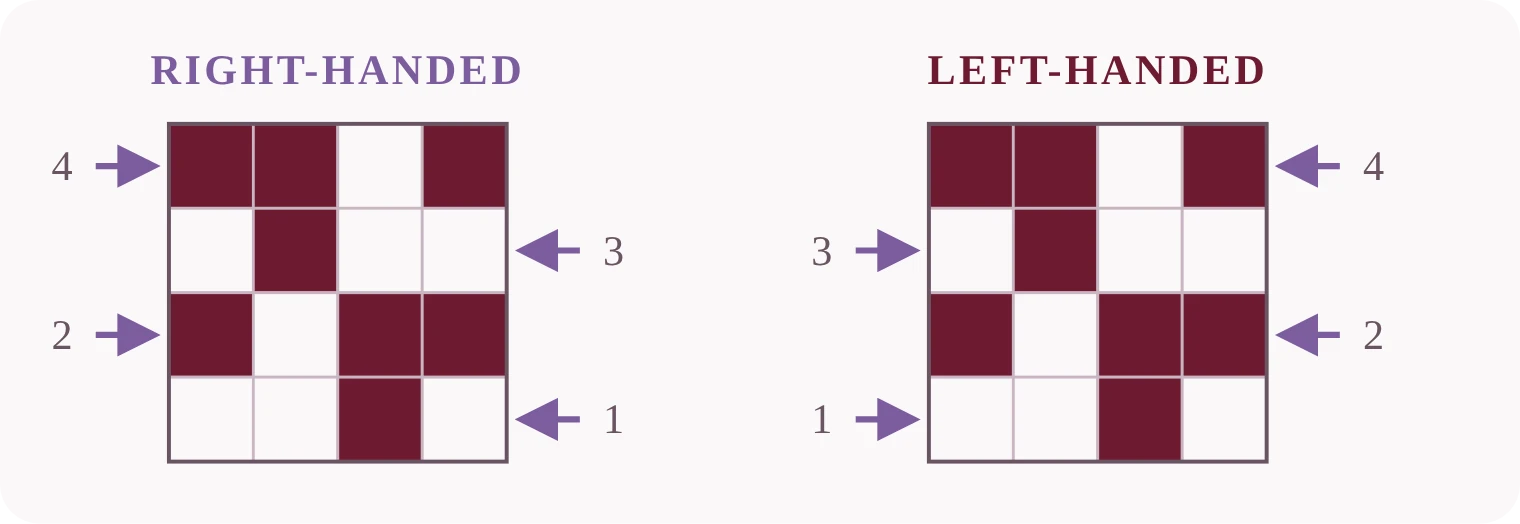
At the end of every row you turn your work, so the direction changes every row. If you crochet right-handed:
- odd rows (1, 3, 5…) are read from right to left,
- even rows (2, 4, 6…) are read from left to right.
You don’t have to remember it: on most charts the row number sits on the side where that row starts. In ours the 1 is on the right, the 2 on the left, and so on up the chart.
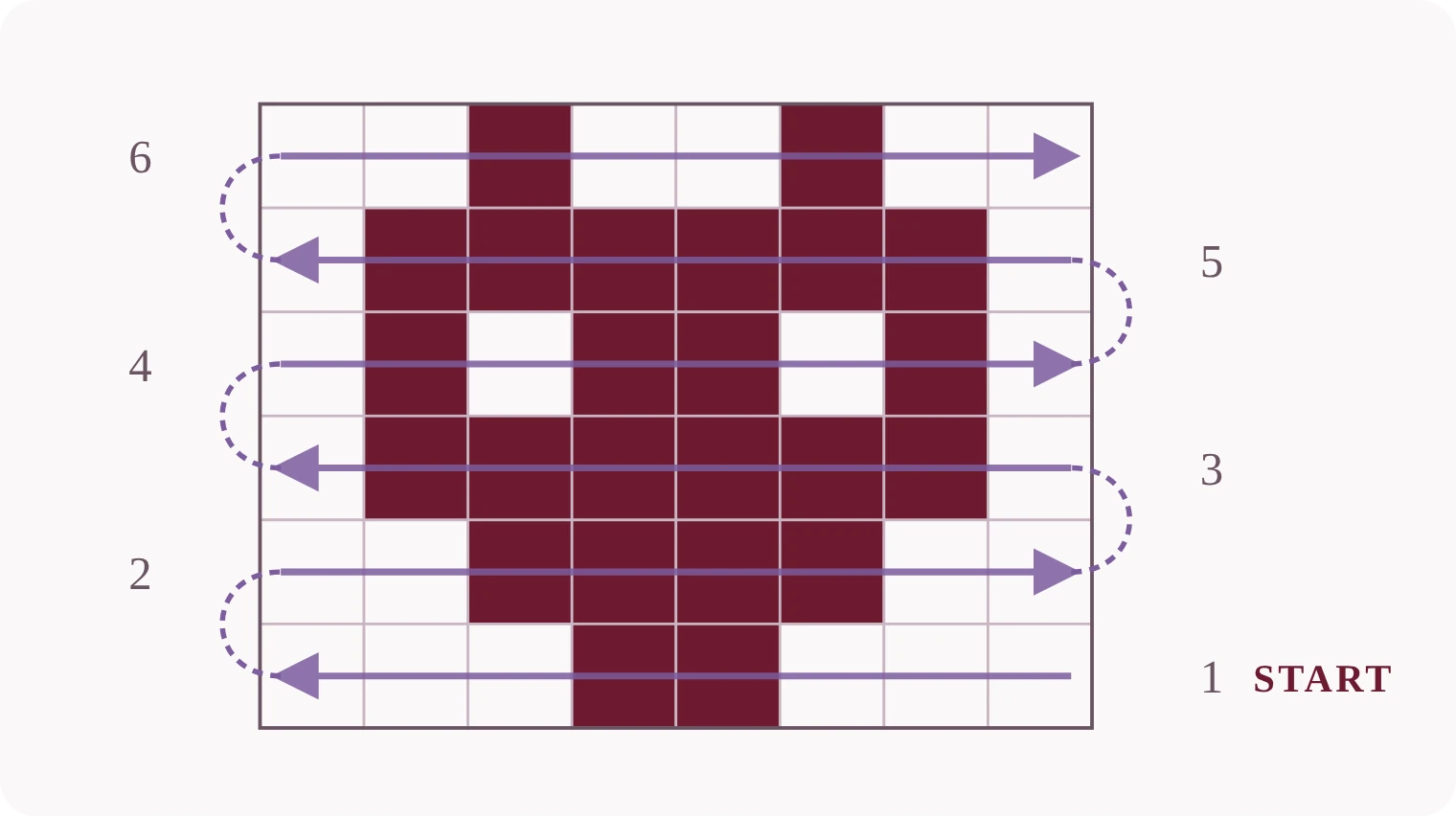
The chart always shows the right side of the lace. On even rows the back of your work faces you. You still crochet from right to left as always, but seen from the front that is left to right, and that is how you follow the chart.
5How many chains to start with
Count the squares in row 1 and call the number N. For the ch-1 mesh, row 1 is worked into a chain of 2N + 3: two chains for each mesh, plus three that stand up as the first dc.
- Chain 2N + 3.
- Skip the first 3 ch from the hook: they count as the first dc.
- Work along the chain, following row 1 from right to left: for a filled mesh, dc in each of the next 2 ch; for an open mesh, ch 1, skip 1 ch, dc in the next ch.
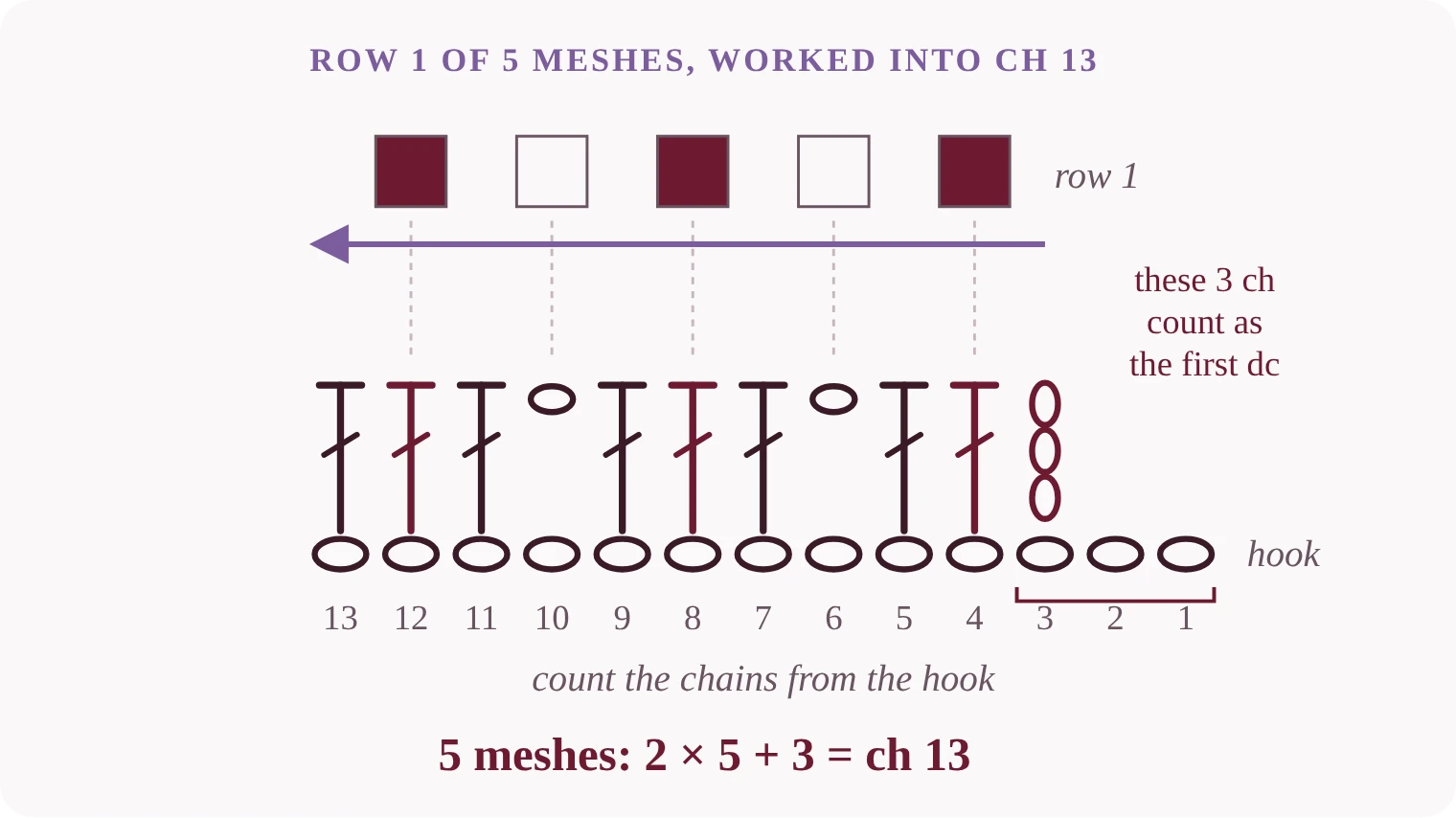
Count the chain twice, or slip a stitch marker into every tenth chain. For a ch-2 mesh the numbers are different, so follow the chain count in your pattern.
6Reading a row without losing your place
Don’t read a row one square at a time. Count runs of the same square instead: “2 open, 6 filled, 2 open” is much easier to hold in your head than ten separate squares. Say the row out loud, or jot it on a sticky note.
Lay a ruler or a strip of paper across the chart just above the row you are working. The rows you have done stay visible below it, and they look just like your lace.
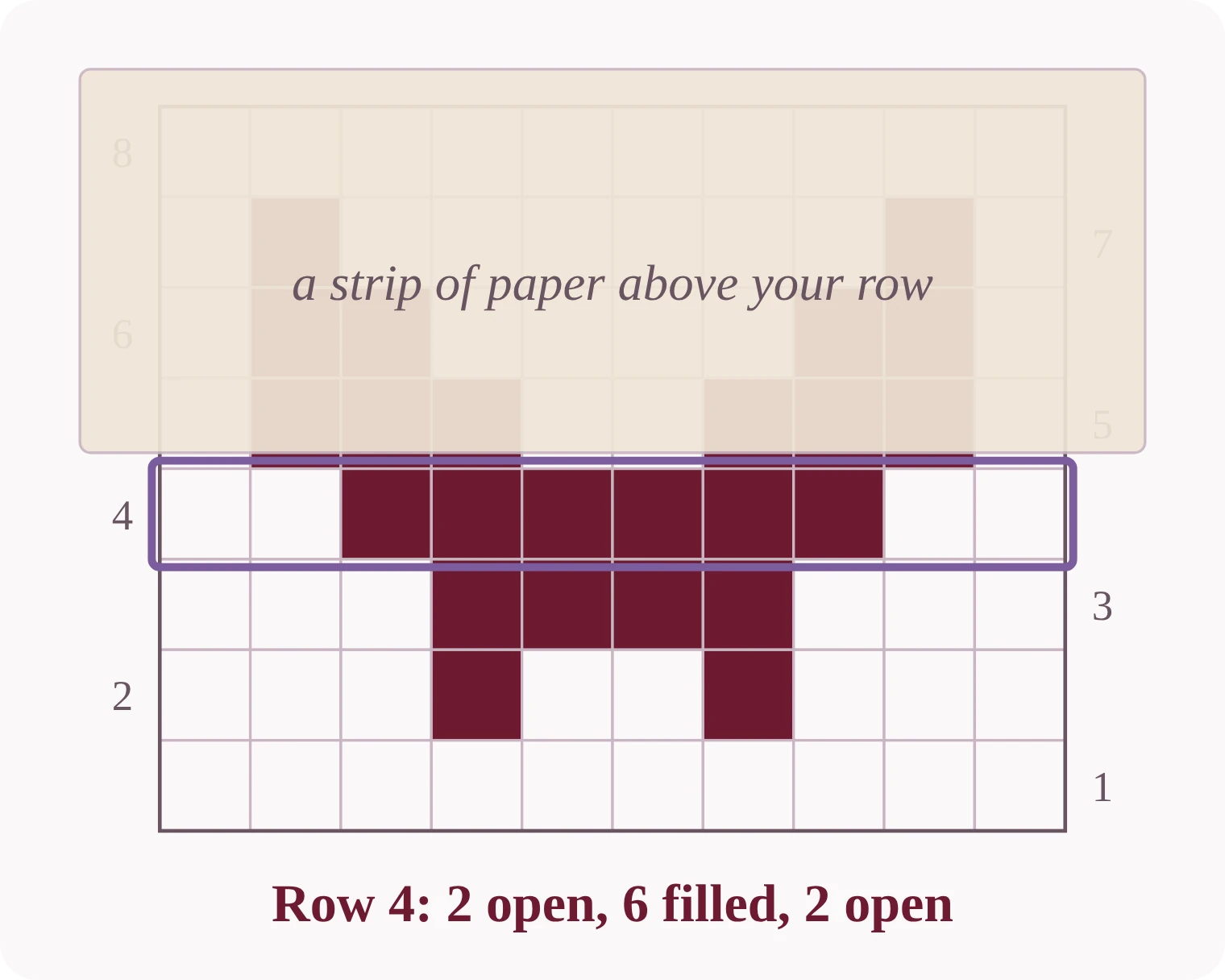
Most of our patterns also spell out every row in words, and many come with a code for the guided row counter on this site, which shows you one row at a time.
7When the chart steps in and out
Shaped charts, like pointed hangings or masks, get wider or narrower at the edges. Where a row starts further in, slip stitch across the meshes that drop out (2 sl st for each mesh), then ch 3 and carry on. Where a row ends earlier, stop where the chart stops and turn. Where a row starts further out, chain the extra stitches first and work the new meshes into them. The pattern gives you the exact counts, and our guide to adding and removing meshes at the edges draws each move out.
8Crocheting left-handed?
Read every row the other way round: row 1 and all the odd rows from left to right, the even rows from right to left. Your first stitch then sits on the left of the work, just where the chart’s row 1 starts, so the picture comes out the same way round, not mirrored.
9Try it on a small chart
The best way to learn is a small chart with nothing but open and filled meshes. Start with the free bookmark, move on to a bigger chart when it feels easy, and keep shaped edges for your third project.
Beetle Bookmark
A stag beetle under a star and a crescent moon, framed by a filled border. A quick project for one evening, and a good first taste of filet crochet.
Epitaphs · I am no bird
A gothic window, an openwork bird and an open cage under Charlotte Brontë’s defiant line.
Aranea · Spooky mask
A spider web across the whole face, with no eye holes: you look out through the lace. Bookmark included.
10Questions
Do you read a filet crochet chart from the top or the bottom?
From the bottom. Row 1 is the lowest row of the chart, and you work upwards, just as the lace grows.
Does a filet chart show the right side or the wrong side?
The right side. On even rows the back of your work faces you, but you still follow the chart, now from left to right.
What does an empty square mean in filet crochet?
An open mesh: a dc, a chain space and the next dc. A filled square is a filled mesh, with a dc in place of the chain.
How many chains do I need for a filet crochet chart?
For the ch-1 mesh, 2 × the number of meshes in row 1, plus 3. Patterns with a ch-2 mesh need a different count, so check your pattern.
Is filet crochet good for beginners?
Yes. It uses just two stitches, chain and double crochet, and a small chart with open and filled meshes only makes a lovely first project.