Learn · Filet crochet basics
Thread and Hook Sizes for Filet Crochet
Crochet thread is numbered the other way round from what you might expect: the higher the number, the finer the thread. Steel hooks are best chosen by their millimetres, and a small swatch tells you how big your lace will be before you start. Here is each step, drawn out with simple sums.
The short version
- The higher the thread number, the finer the thread: size 30 is finer than size 20, and size 20 is finer than size 10.
- Choose hooks by millimetres. US steel hook numbers run the other way, and brands don’t always agree on them.
- Start with the hook on the ball band, then let your swatch decide.
- The chart never changes. The thread, the hook and your hands decide how big each mesh is, and so how big the whole piece is.
- Finished size = meshes on the chart ÷ meshes per 10 cm × 10.
1What the numbers on crochet thread mean
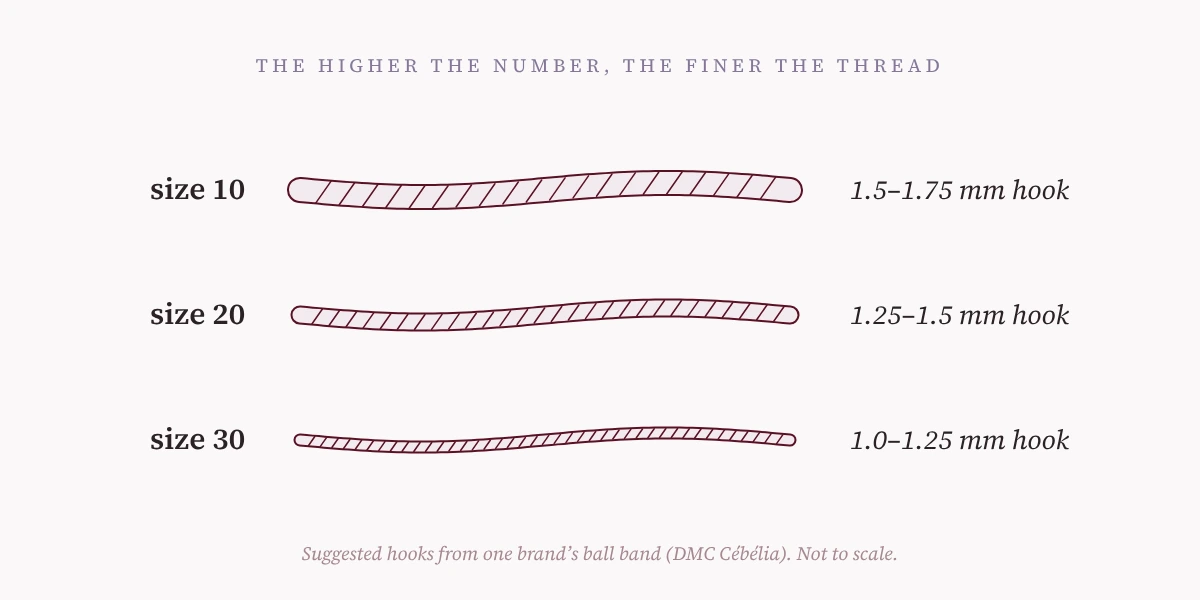
Choosing a filet crochet thread size starts with knowing how thread is numbered. Crochet thread is sold by number: 3, 5, 10, 20, 30, and finer still, all the way to 100. It’s easy to read these the wrong way round. The number goes up as the thread gets finer, so size 10 is the thickest of the three in the drawing below, and size 30 is the finest.
Size 10 is a good place to start. It’s fine enough to look like lace, but thick enough to see every stitch and count your meshes without squinting.
Brands differ a little, so two “size 10” threads won’t be exactly alike. The ball band is your friend: it usually tells you how many metres are in the ball and which hook the maker suggests.
Mercerised? You’ll often see “mercerised cotton” on the ball band. That’s cotton treated to make it smoother, stronger and shinier, which suits lace nicely. DMC, for example, describes its Cébélia thread as “double mercerised for brilliance and strength”.
2Steel hooks: millimetres and US numbers
The small hooks used with thread are usually made of steel, so you’ll see them called steel hooks. They’re labelled in two ways:
- In millimetres (1.5 mm, 1.25 mm and so on). The bigger the number, the bigger the hook. Easy.
- With US steel hook numbers. These run the other way round: the bigger the number, the smaller the hook.
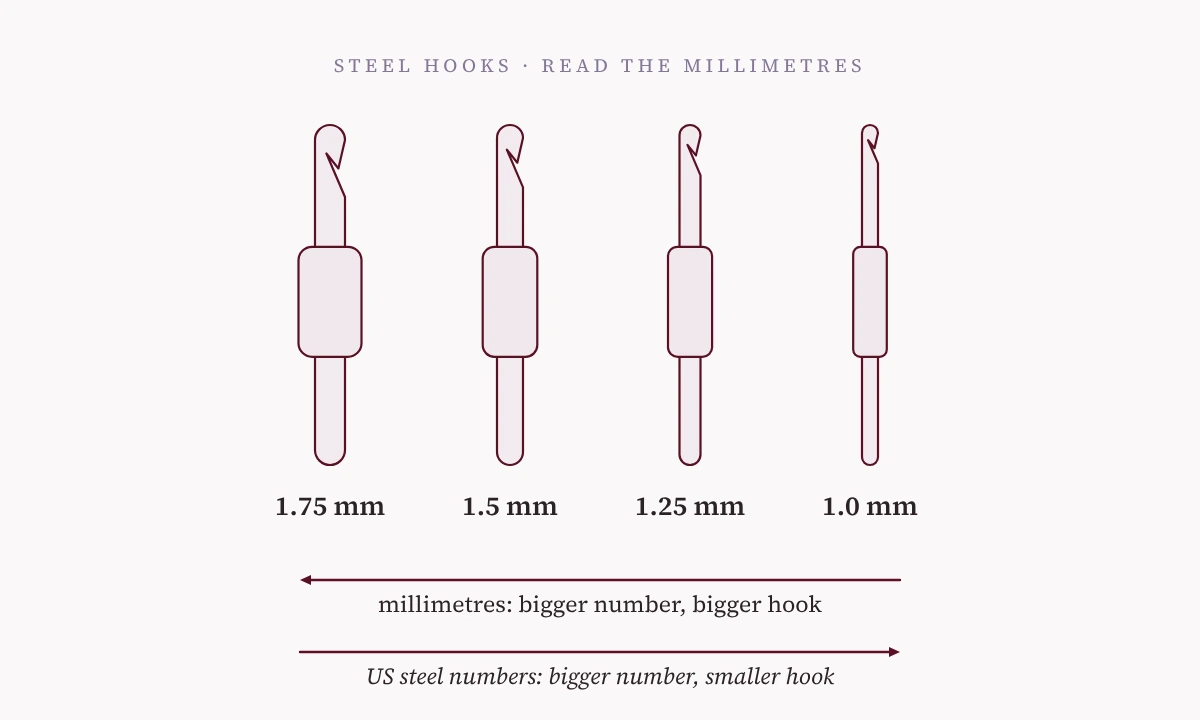
To make things more confusing, brands don’t always give the same US number to the same millimetre size. So choose and compare hooks by the millimetres printed on them, and treat a US number as a rough guide. If a pattern gives only a US number, look it up in the Craft Yarn Council’s steel hook chart and then check the millimetres on your hook.
That’s why our patterns give the hook in millimetres. The Beetle Bookmark, Aranea and Epitaphs · I am no bird all use a 1.5 mm hook.
3Matching the hook to the thread
The finer the thread, the smaller the hook. As a starting point, this is what DMC suggests on the ball band of its Cébélia thread:
- size 10: 1.5–1.75 mm
- size 20: 1.25–1.5 mm
- size 30: 1.0–1.25 mm
Other brands may suggest something a little different, so check the band of the thread you have.
That’s where you start. Your swatch tells you where to finish:
- Loose, wobbly meshes that won’t hold their square shape? Try a hook 0.25 mm smaller.
- Stiff fabric, or a hook that struggles to get into the stitches? Try a hook 0.25 mm bigger.
- Lace looks lovely, but the size is wrong? That’s a gauge question. Read on.
Two people can use the same thread and the same hook and still crochet different meshes. That’s completely normal, and it’s exactly what a swatch is for.
4How thread and hook change the size of a mesh
A chart tells you how many meshes to make. It doesn’t tell you how big they are. That comes from the thread, the hook and your tension.
Two of our patterns show this nicely. Both use a 1.5 mm hook:
- Aranea uses size 10 cotton thread and works out at 25 meshes and 20 rows per 10 cm. Each mesh is 4 mm wide and 5 mm tall.
- Epitaphs · I am no bird uses DelicaMax cotton and works out at 20 meshes and 20 rows per 10 cm. Each mesh is about 5 mm square.
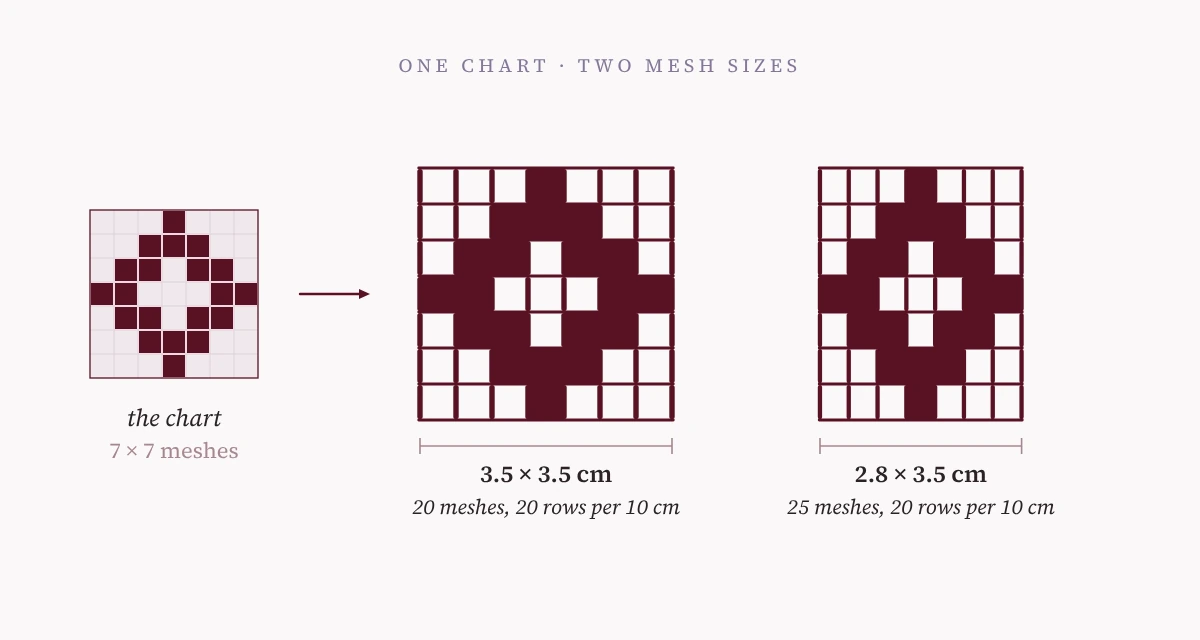
This is good news. To make a piece bigger or smaller, you don’t need a new chart. Change the thread and hook, and the same chart grows or shrinks. A finer thread gives a smaller, more delicate piece; a thicker one gives a bigger, bolder one.
Notice one more thing in the drawing: meshes aren’t always square. In Aranea they’re a little taller than they are wide, so the picture stretches upwards slightly. That’s why you always measure in both directions.
5Measure a swatch, then work out the finished size
A swatch takes an evening and can save you a whole project. Enchanted Garden, our filet shawl, asks for exactly this before you begin.
- Crochet about 20 × 20 meshes in the thread and hook you plan to use, with open and filled meshes as in the pattern. For 20 meshes, start with 43 chains: 2 × 20 + 3 (see How to Read a Filet Crochet Chart).
- Block it the same way you’ll block the finished piece, because blocking can change the size. How to Starch and Shape Crochet Lace shows how.
- Measure 10 meshes across, in the middle of the swatch, away from the edges.
- Measure 10 rows up, also in the middle.
- Turn both into “per 10 cm”: 10 ÷ your measurement in cm × 10.
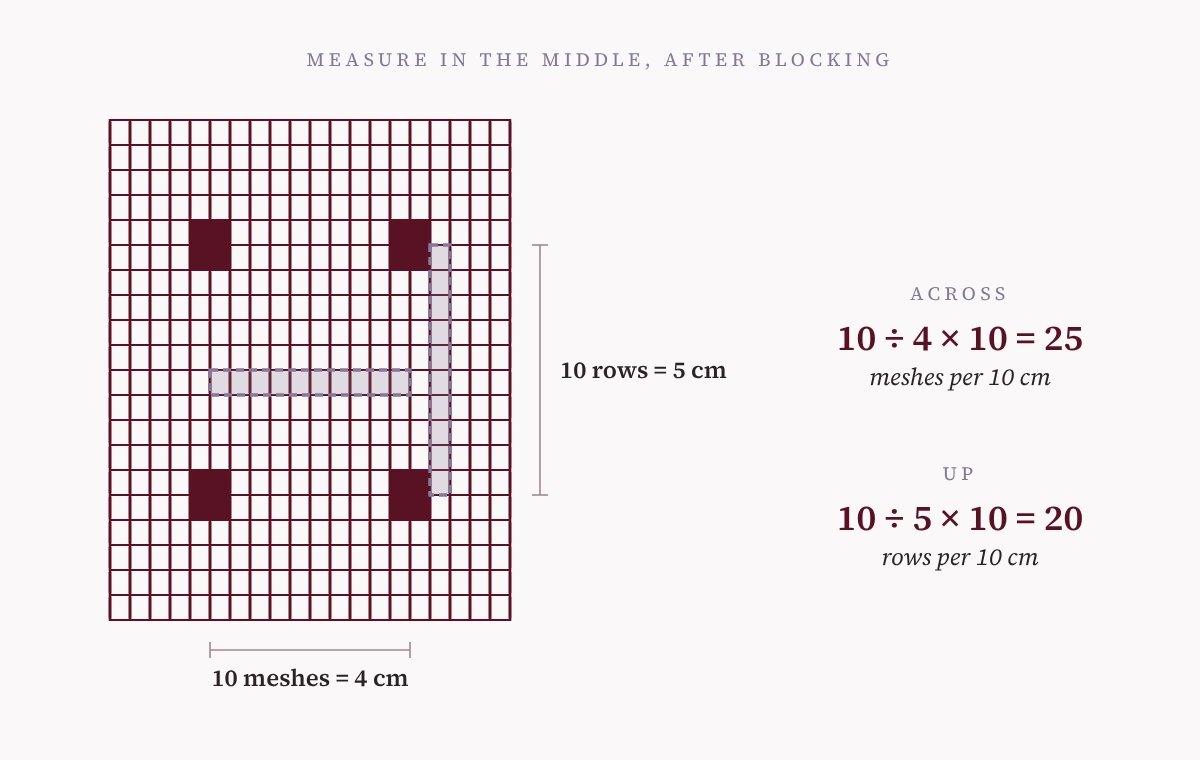
So if 10 meshes measure 4 cm, that’s 10 ÷ 4 × 10 = 25 meshes per 10 cm. If 10 rows measure 5 cm, that’s 10 ÷ 5 × 10 = 20 rows per 10 cm.
Now you can work out the size of anything, before you make a single chain:
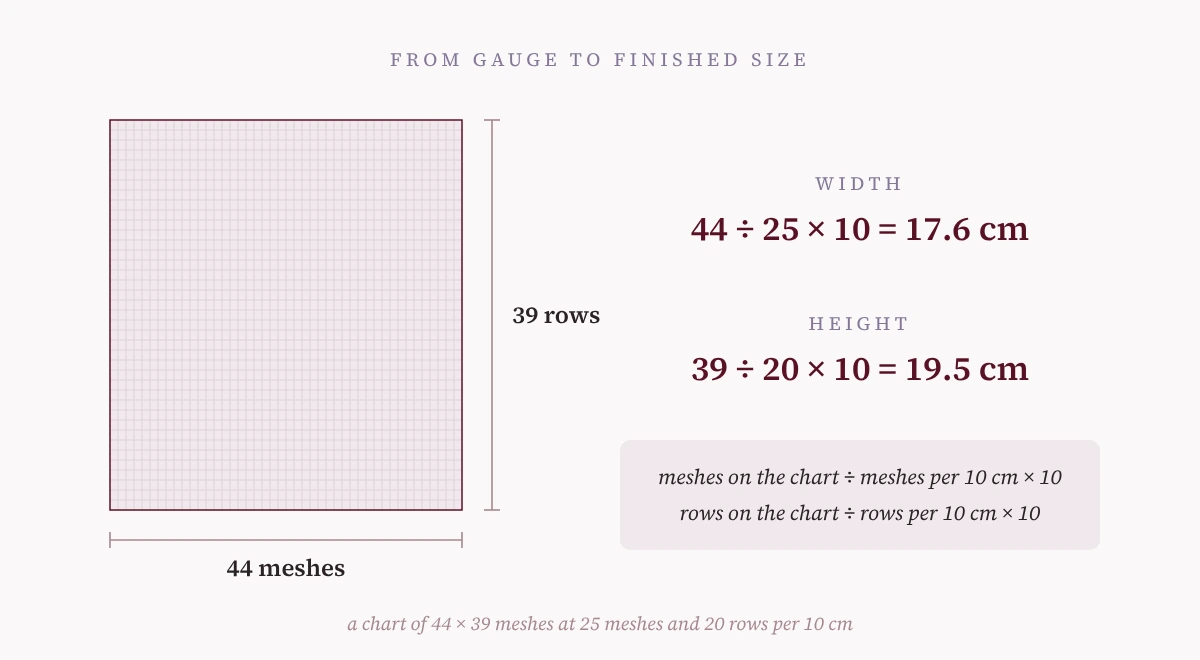
- Width = meshes across the chart ÷ meshes per 10 cm × 10
- Height = rows on the chart ÷ rows per 10 cm × 10
Let’s try it on Aranea. The chart is 44 meshes wide and 39 rows tall, and the gauge is 25 meshes and 20 rows per 10 cm:
- Width: 44 ÷ 25 × 10 = 17.6 cm
- Height: 39 ÷ 20 × 10 = 19.5 cm
That’s exactly the size given in the pattern, before the edging.
And if your swatch comes out different? Say you get 20 meshes per 10 cm instead of 25. The same mask would be 44 ÷ 20 × 10 = 22 cm wide, more than 4 cm wider. For a mask that has to fit a face, that matters. Try a smaller hook or a finer thread, make another small swatch, and do the sum again.
Prefer inches? Count the meshes in 4 inches instead and multiply by 4 instead of 10.
6Try it on a small chart
The quickest way to see your own mesh size is a small, real piece. Each of these gives its hook and finished size, so you can compare your work with the pattern: start with the free bookmark.
Beetle Bookmark
A stag beetle under a star and a crescent moon, framed by a filled border. A quick project for one evening, and a good first taste of filet crochet.
Epitaphs · I am no bird
A gothic window, an openwork bird and an open cage under Charlotte Brontë’s defiant line.
Aranea · Spooky mask
A spider web across the whole face, with no eye holes: you look out through the lace. Bookmark included.
7Questions
What size thread is best for filet crochet?
Size 10 is a good place to start: fine enough to look like lace, thick enough to see every stitch. A light, plain colour makes counting meshes easier still.
What size hook do I need for size 10 crochet thread?
Start with the hook on the ball band. DMC suggests 1.5–1.75 mm for its size 10 Cébélia, and our filet patterns use a 1.5 mm hook. Then let your swatch decide.
Can I use a different thread from the one in the pattern?
Yes. The chart stays the same; only the size changes. Make a swatch, work out your gauge and use the sums in section 5 to see how big your piece will be.
My pattern only gives a US hook number. What do I do?
Look up the millimetre size for that number, then check the millimetres printed on your hook. If you’re between two sizes, your swatch decides.
Why is my filet crochet taller than I expected?
Your meshes are probably a little taller than they are wide. Measure rows per 10 cm separately from meshes per 10 cm, and use each one in its own sum.
Do I measure my swatch before or after starching?
After. Block your swatch exactly as you’ll block the finished piece, then measure.