Learn · Filet crochet basics
How to Fix a Mistake in Filet Crochet
Almost every filet mistake can be fixed. Count each row before you turn and compare it with the chart; if something is wrong, pull the thread back to the mistake, put the hook in the live loop and carry on. Here is how to spot it, undo it and keep it from happening again.
The short version
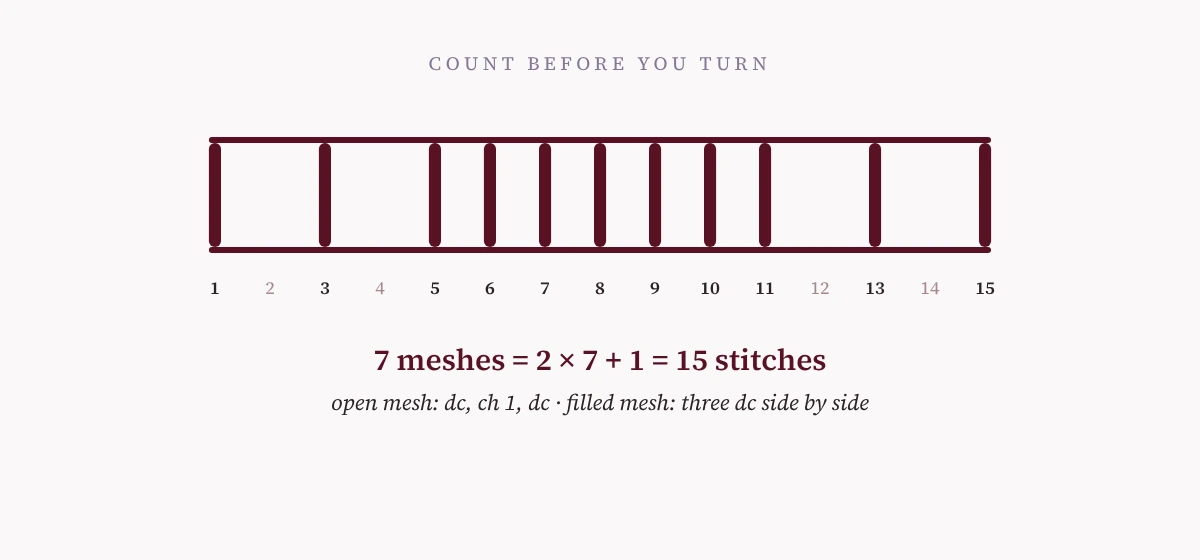
- Count before you turn: a row of N meshes has 2N + 1 stitches.
- Compare each row with the chart, on the right side of the lace, reading it as runs.
- A mistake in this row: pull the thread back to it and put the hook in the live loop.
- A mistake further down: rip back the rows above it, then crochet them again.
- Edges creeping in or out: check the first stitch and the last dc into the turning chain.
1Check every row before you turn
Most filet mistakes are easy to fix if you catch them at the end of the row where they happen. So before you turn, take a few seconds to check two things.
- Count the stitches. A row of N meshes has 2N + 1 stitches: one post to start with, then two stitches for every mesh. Seven meshes make 15 stitches.
- Read the row back against the chart. Count runs, not single squares: “2 open, 3 filled, 2 open” is quick to check.
A stitch marker helps at the edges. When you make the ch 3 at the start of a row, clip a marker into the top chain. At the end of the next row you’ll know exactly where the last double crochet (dc) goes. We use US terms; in UK terms the dc is a treble (tr).
2How to spot a wrong mesh
A filet chart is a picture of your lace seen from the right side, so a mistake usually jumps out when you hold the two side by side: a hole where the chart has a filled square, or a solid block where it should be open.
On even rows the back of the work faces you. Flip the lace to the right side before you compare it with the chart.
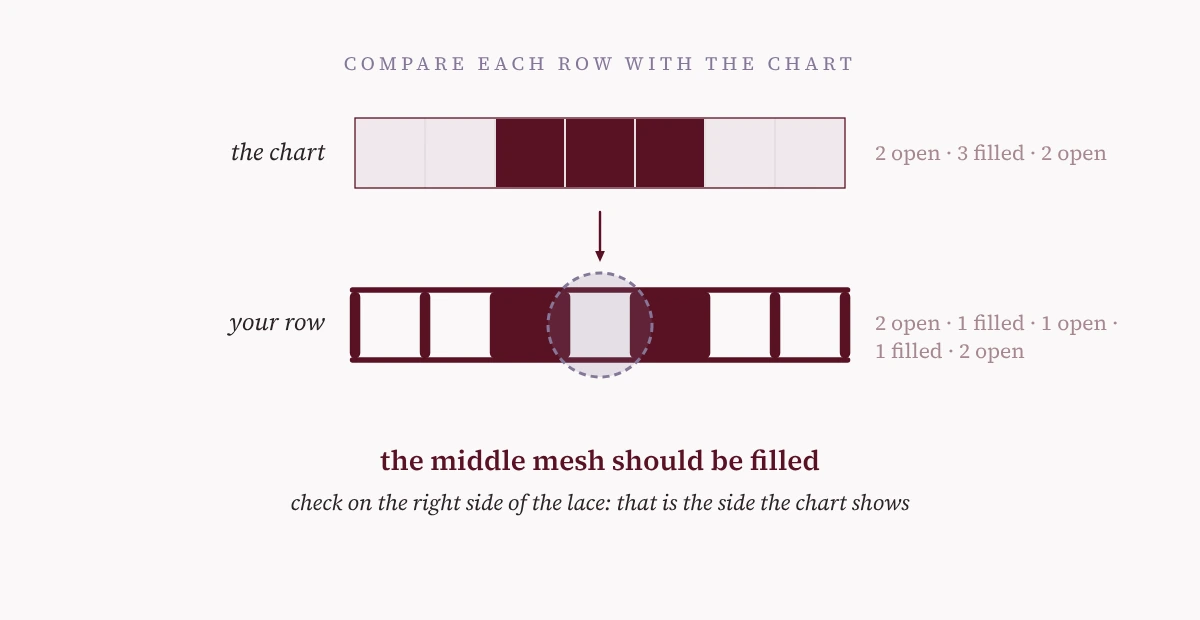
The three mistakes you’ll meet most often:
- Open instead of filled, or the other way round: one mesh in the wrong place.
- A whole run shifted by a mesh: usually a miscount early in the row.
- An edge that creeps in or out: a stitch missed or added at the end or start of a row. More on that below.
3Fix the row you’re on: unpick back to the mistake
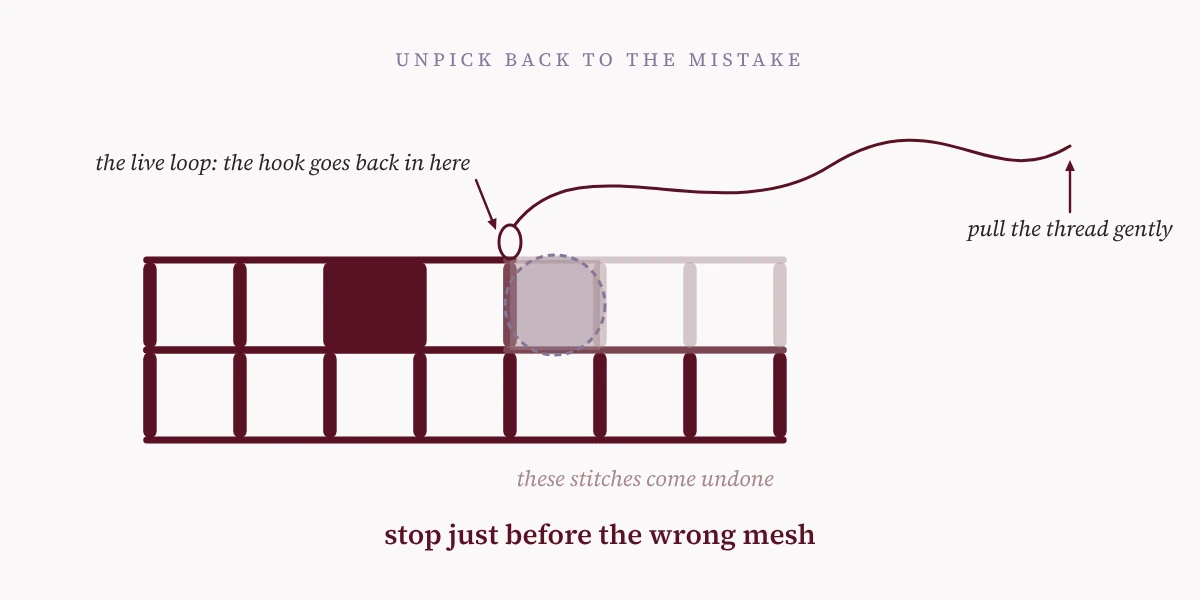
Crochet is kind to mistakes. There is only ever one live loop, the one on your hook, so you can undo stitches without anything else coming loose.
- Take the hook out of the loop.
- Pull the working thread gently. The stitches come undone one by one, the last one first.
- Stop just before the wrong mesh, put the hook back into the live loop and snug the thread.
- Count from the start of the row to check you are where you think you are, then crochet on.
4A mistake a few rows down: rip back
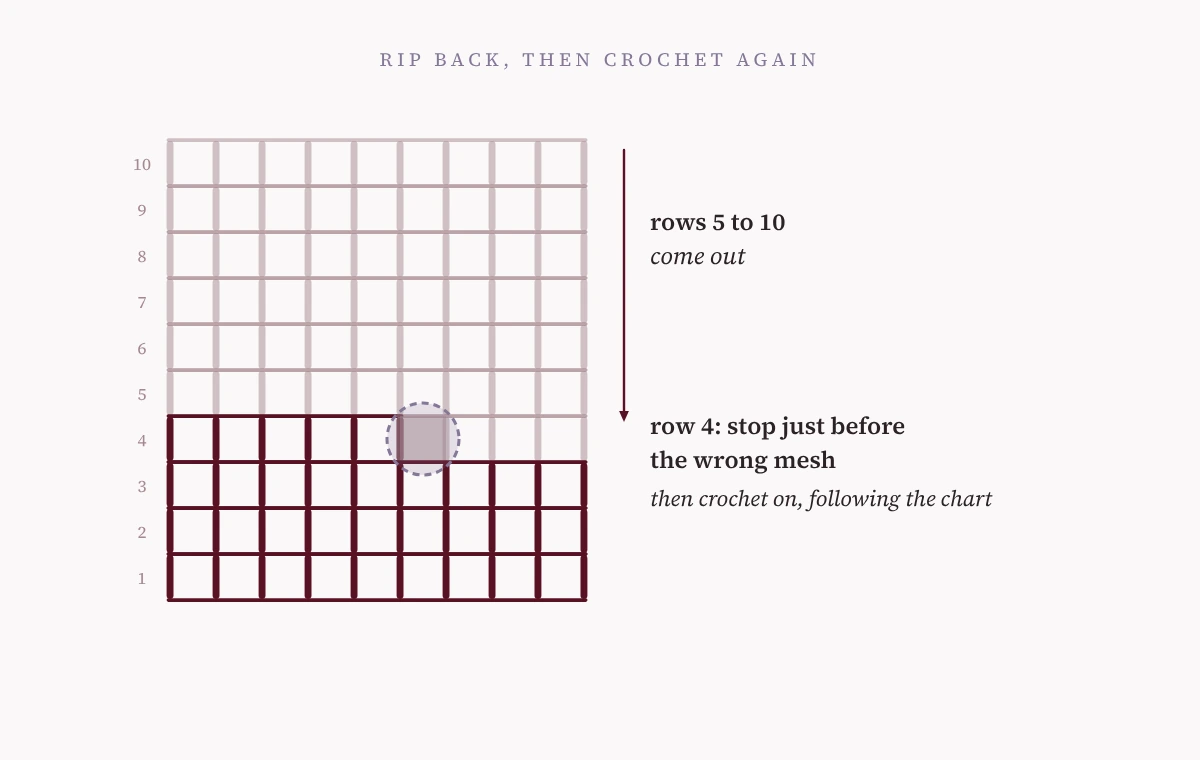
If the wrong mesh is further down, the rows above it have to come out too. Crocheters call this frogging: “rip it, rip it” sounds a little like a frog’s “ribbit”.
- Note the number of the row with the mistake, so you know which way that row runs on the chart.
- Take the hook out and pull the thread to undo whole rows, down into the row with the mistake.
- Go slowly in that last row and stop just before the wrong mesh.
- Put the hook back into the live loop and carry on from there, following the chart.
Rip back or leave it? It’s your lace, and your call. A wrong mesh in the open background is often hard to see from a distance, while one inside the picture tends to catch the eye. Lay the piece flat, step back and decide.
5When the edges creep in or out
If your lace is slowly getting narrower or wider, look at the first and last stitches of each row: they are the easiest ones to miss. In our patterns the ch 3 at the start of a row counts as the first dc, so:
- Don’t work a dc into the first stitch of the row: the ch 3 already stands there. An extra stitch makes the edge creep out.
- Do work the last dc into the top of the turning chain of the row below, the 3rd of its 3 chains. Missing it drops a stitch, and the edge creeps in.
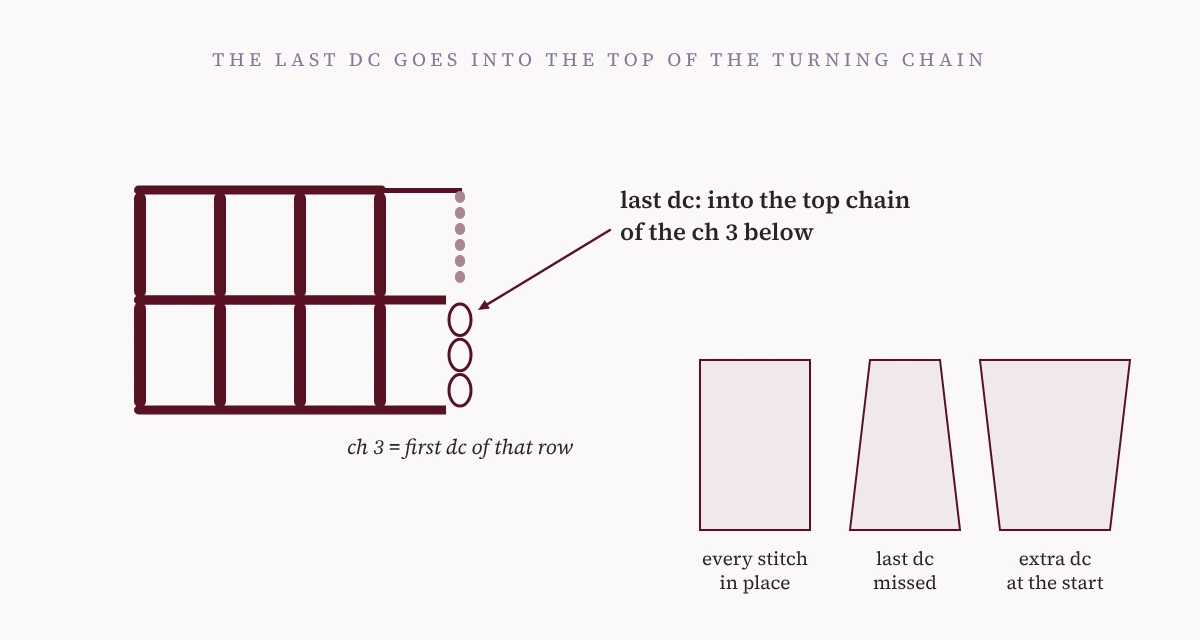
Blocking can’t put a missing stitch back, so it’s worth catching early, and counting 2N + 1 at the end of each row finds it straight away. If the count is right but the edge still looks bumpy, your turning chains may simply be a little tall for your tension.
6Keep mistakes from happening
- Cover the rows ahead with a strip of paper, as in How to Read a Filet Crochet Chart, so your eye stays on the right row.
- Tick off each row on a printed chart as you finish it, or follow the pattern in the guided row counter on this site, which shows you one row at a time.
- Put a marker every 10 meshes in long rows, so you only ever count to ten.
- Stop at the end of a row, not in the middle, when you put your work down.
And when the edges have to step in or out on purpose, our guide to adding and removing meshes at the edges shows each move.
7Practise on a small chart
Mistakes are easiest to catch in short rows. A small chart is the best place to practise counting and checking each row before you take on something bigger.
Beetle Bookmark
A stag beetle under a star and a crescent moon, framed by a filled border. A quick project for one evening, and a good first taste of filet crochet.
Epitaphs · I am no bird
A gothic window, an openwork bird and an open cage under Charlotte Brontë’s defiant line.
Aranea · Spooky mask
A spider web across the whole face, with no eye holes: you look out through the lace. Bookmark included.
8Questions
How do you undo crochet stitches?
Take the hook out and gently pull the working thread: the stitches come undone one at a time. Stop where you want, put the hook back into the live loop and carry on.
What does frogging mean in crochet?
Ripping out your work. The name comes from “rip it, rip it”, which sounds like a frog’s “ribbit”.
Why is my filet crochet getting narrower?
Most often a stitch is being missed at the end of the row. The last dc belongs in the top of the turning chain of the row below.
Why is my filet crochet getting wider?
Usually there’s an extra stitch at the start of the row. When the ch 3 counts as the first dc, don’t work another dc into the first stitch.
Can blocking fix a missing stitch or a wrong mesh?
No. Blocking evens out the shape, but it can’t add a missing stitch or turn an open mesh into a filled one.
How do I stop losing my place on a filet chart?
Cover the rows ahead with a strip of paper, read each row as runs and tick it off when it’s done, or follow the pattern in the guided row counter.